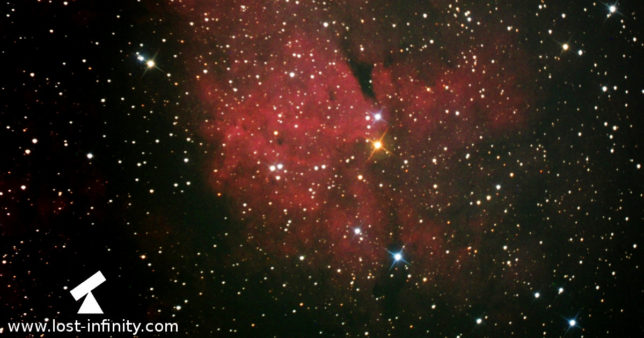


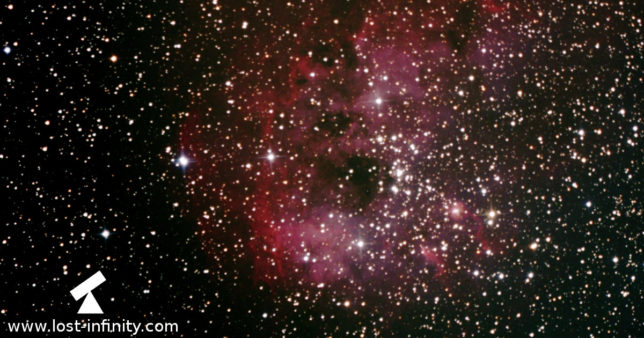
Imaging emission nebula IC410 & open cluster NGC 1893

IC410 is an emission nebula in constellation Auriga. It was discovered 1892 by Max Wolf, a German astronomer. It’s apparent magnitude is around 7.5 mag. Embedded into the IC410 emission nebula is the open cluster NGC 1893. It is about 12,400 light years away and contains ~4600 stellar objects.

The image is also available in full resolution.

Date2013/10/02
LocationBöblingen / Germany
ObjectIC410
CameraAtik383L+
Guidingyes, DMK31AU03.AS via OAG
Telescope8" GSO Newtonian
Barlow lensnone
MountEQ6Syntrek
Cooling-15°C
Luminance7x 800s, bin: 1x1
Red7x 200s, bin: 2x2
Green7x 200s, bin: 2x2
Blue7x 200s, bin: 2x2
Dark5x
Flat-
Total exposure~2h43m

Clear skies!

Last updated: June 20, 2022 at 10:22 am
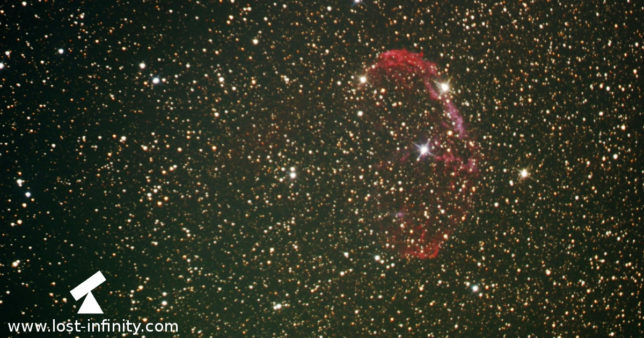
Imaging the Crescent Nebula (NGC6888) without UHC and OIII filter

The Crescent Nebula is an emission nebula in constellation Cygnus. It was discovered by William Herschel in 1792. The apparent magnitude is around 7.4mag.

I imaged the nebula without UHC or OIII filter – that’s why is actually looks quite unspectacular.

The image is also available in full resolution.

Date2013/09/24
LocationBöblingen / Germany
ObjectNGC6888
CameraAtik383L+
Guidingyes, DMK31AU03.AS via OAG
Telescope8" GSO Newtonian
Barlow lensnone
MountEQ6Syntrek
Cooling-15°C
Luminance4x 800s, bin: 1x1
Red4x 200s, bin: 2x2
Green4x 200s, bin: 2x2
Blue4x 200s, bin: 2x2
Dark4x
Flat-
Total exposure~1h33min.

Clear skies!

Last updated: June 20, 2022 at 10:23 am

Astrophotography – Gamma-Cygni-Nebula – Part 2 (IC1318)

The image is also available in full resolution.

Date2013/09/24
LocationBöblingen / Germany
ObjectGamma-Cygni-Nebula (IC1318) - Part 2
CameraAtik383L+
Guidingyes, DMK31AU03.AS via OAG
Telescope8" GSO Newtonian
Barlow lensnone
MountEQ6Syntrek
Cooling-15°C
Luminance3x 800s, bin: 1x1
Red3x 200s, bin: 2x2
Green3x 200s, bin: 2x2
Blue3x 200s, bin: 2x2
Dark4x
Flat-
Total exposure~1h10min.

Clear skies!

Last updated: June 20, 2022 at 10:25 am

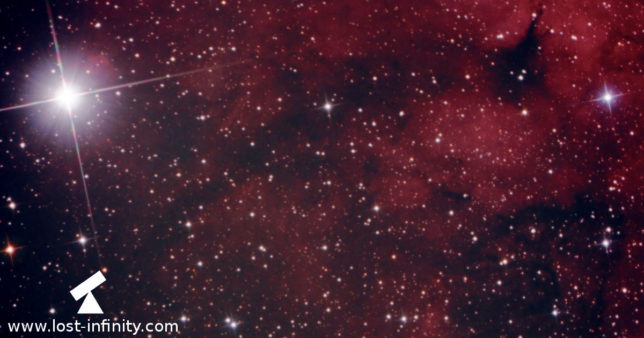
Astrophotography – Gamma-Cygni-Nebula (IC1318)

Gamma-Cygni-Nebula (IC1318) – also known as Sadr Region – is a diffuse emission nebula in constellation Cygnus. It is about 1500 ly away from earth. It was discovered 1893 by Edward Barnard (not to be confuse with Edward Bernays …), an astronomer from the US. He was one of the pioneers of astrophotography.

Date2013/09/23
LocationBöblingen / Germany
ObjectGamma-Cygni-Nebula (IC1318)
CameraAtik383L+
Guidingyes, DMK31AU03.AS via OAG
Telescope8" GSO Newtonian
Barlow lensnone
MountEQ6Syntrek
Cooling-15°C
Luminance3x 800s, bin: 1x1
Red3x 200s, bin: 2x2
Green3x 200s, bin: 2x2
Blue2x 200s, bin: 2x2
Dark4x
Flat-
Total exposure~1h06min.

The bright star to the top left corner is Gamma Cygni, forming the intersection of an asterism of five stars called the Northern Cross. According to latest measurements it is approximately 1800 ly away from the sun.

The image is also available in full resolution.

Clear skies!

Last updated: June 20, 2022 at 10:27 am

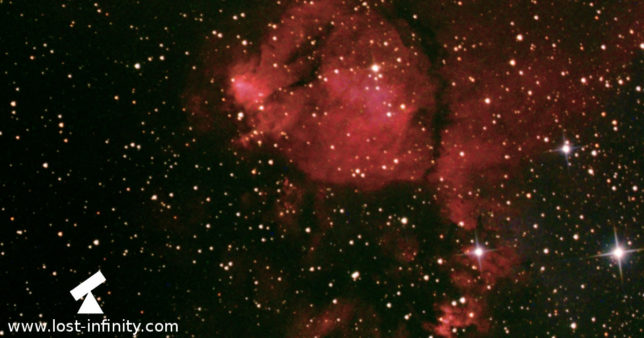
Astrophotography – Heart Nebula (IC1805)

The Heart Nebula (IC1805) is about 7500 ly. away from our earth and located in constellation Cassiopeia. It was already discovered by William Herschel in 1787. With a bit of fantasy one can guess why the nebula was named Heart Nebula. The Heart Nebula is an emission nebula consisting of ionized hydrogen gas and dark dust lanes.

Date2013/09/05
LocationBöblingen / Germany
ObjectHeart Nebula (IC1805)
CameraAtik383L+
Guidingyes, DMK31AU03.AS via OAG
Telescope8" GSO Newtonian
Barlow lensnone
MountEQ6Syntrek
Cooling-15°C
Luminance10x 800s, bin: 1x1
Red10x 200s, bin: 2x2
Green10x 200s, bin: 2x2
Blue10x 200s, bin: 2x2
Dark4x
Flat-
Total exposure~3h53min.

The image is also available in full resolution.

Clear skies!

Last updated: June 20, 2022 at 10:28 am