

Astrophotography – Triangulum Galaxy (M33), again

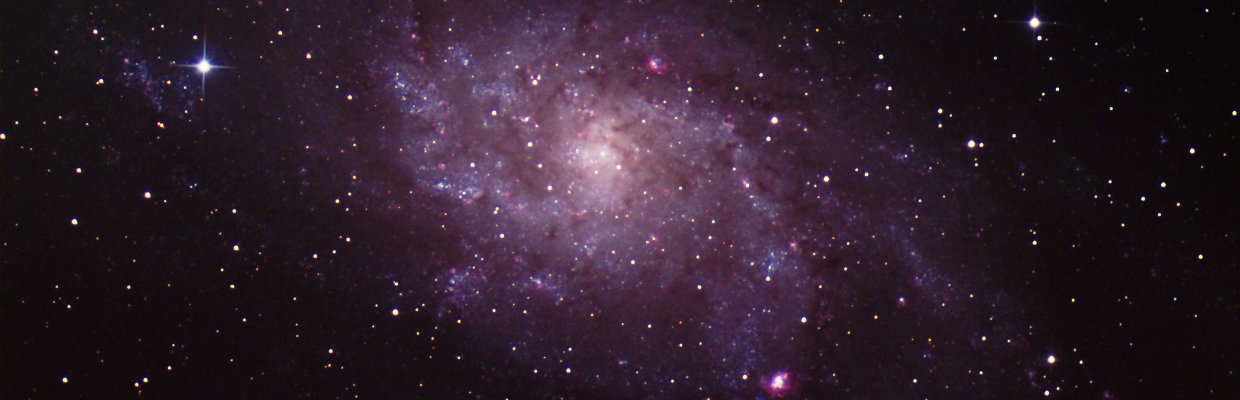
The Triangulum Galaxy is a spiral galaxy around 2.7 million ly. away from Earth. It is located in the constellation Triangulum. The Triangulum Galaxy is the third-largest member of the Local Group of galaxies, right after the Andromeda Galaxy and the Milky Way. For me this one of the best pictures I was able to capture so far. And again it is amazing to see what is possible with an amateur telescope and a mid-range CCD camera!

Date2014/09/20
LocationBöblingen / Germany
ObjectTriangulum Galaxy (M33)
CameraAtik383L+
Guidingyes, DMK31AU03.AS via OAG
Telescope8" GSO Newtonian
Barlow lensnone
MountEQ6Syntrek
Cooling-15°C
Luminance6x 600s, bin: 1x1
Red5x 300s, bin: 2x2
Green5x 300s, bin: 2x2
Blue5x 300s, bin: 2x2
Dark10x
Flat10x
Total exposure~2h15m

The image is also available in full resolution.

Clear skies!

Last updated: June 20, 2022 at 9:43 am

Astrophotography – Pelican Nebula (IC5070), again

The Pelican Nebula (IC5070) is an emission nebula in an H II region in constellation Cygnus. The nebula is about 1800 ly away from earth. Looking at the picture it becomes clear why it’s name is Pelican Nebula.

The image is also available in full resolution.

Date2014/07/03
LocationBöblingen / Germany
ObjectPelican Nebula (IC5070)
CameraAtik383L+
Guidingyes, DMK31AU03.AS via OAG
Telescope8" GSO Newtonian
Barlow lensnone
MountEQ6Syntrek
Cooling-15°C
Luminance8x 600s, bin: 1x1
Red5x 300s, bin: 2x2
Green5x 300s, bin: 2x2
Blue5x 300s, bin: 2x2
Dark10x
Flat10x
Total exposure~2h35m

Clear skies!

Last updated: June 20, 2022 at 9:54 am

Greetings from Hercules – Globular Cluster (M13)

Messier 13 (NGC 6205) is a globular cluster of several hundred thousand stars in the constellation Hercules. M13 is also known as Hercules Globular Cluster. Edmond Halley discovered it already in 1714. The globular cluster has an apparent magnitude of 5,8 mag and therefore is well suited for observation and astrophotography by amateur astronomers.

Date2014/06/25
LocationBöblingen / Germany
ObjectGlobular Cluster (M13)
CameraAtik383L+
Guidingyes, DMK31AU03.AS via OAG
Telescope8" GSO Newtonian
Barlow lensnone
MountEQ6Syntrek
Cooling-15°C
Luminance12x 400s, bin: 1x1
Red10x 200s, bin: 2x2
Green10x 200s, bin: 2x2
Blue10x 200s, bin: 2x2
Dark9x
Flat10x
Total exposure~2h46m

The image is also available in full resolution.

Clear skies!

Last updated: June 20, 2022 at 9:55 am

Having a look at the Pinwheel Galaxy (M101)

The Pinwheel Galaxy M101 (NGC 5457) is a spiral galaxy in constellation Ursa Major. It is about 21 million ly away from earth. The apparent magnitude of this galaxy is ~7.8 mag. Therefore, this object is well suited for astrophotography with equipment like mine.

There is also a full resolution image of M101 available. UPDATE: I finally decided to put this picture into My Top Astro-Pics gallery.

Date2014/02/23
LocationBöblingen / Germany
ObjectPinwheel Galaxy (M101)
CameraAtik383L+
Guidingyes, DMK31AU03.AS via OAG
Telescope8" GSO Newtonian
Barlow lensnone
MountEQ6Syntrek
Cooling-15°C
Luminance12x 800s, bin: 1x1
Red9x 450s, bin: 2x2
Green9x 450s, bin: 2x2
Blue9x 450s, bin: 2x2
Dark10x
Flat10x
Total exposure~6h02min

Clear skies!

Last updated: June 20, 2022 at 9:58 am

The Great Orion Nebula – A second try

Actually this motif – the Great Orion Nebula (M42) – was one of the first nebula I have ever tried since starting with astrophotography. I was already quite satisfied with the first result (maybe because I didn’t know better :)). Tonight I decided to give it another try. Personally I think it is much better than the last one. The image is also available in full resolution.

Date2014/02/07
LocationBöblingen / Germany
ObjectM42 (The Great Orion Nebula)
CameraAtik383L+
Guidingyes, QHY5-II Mono via OAG
Telescope8" GSO Newtonian
Barlow lensnone
MountEQ6Syntrek
Cooling-15°C
Luminance2x, 2s, 20s, 100s, 200s, 600s, bin: 1x1
Red2x, 2s, 20s, 100s, 200s, 400s, bin: 2x2
Green2x, 2s, 20s, 100s, 200s, 400s, bin: 2x2
Blue2x, 2s, 20s, 100s, 200s, 400s, bin: 2x2
Dark10x
Flat10x
Total exposure~1h43min.

Clear skies!

Last updated: June 20, 2022 at 10:02 am